Ahn Ha Jung
Hajung Ahn (1996)
Education
2023 present Burg Giebichenstein University of Art, Germany , Grafik (Dip)
2020 Sungshin Women’s University, South Korea, Fine Art (BA)
exhibitions
2025 Abstract Mind 2025 (CICA Museum, Gimpo,,Korea)
2024 Anonymous Drawings (Berlin, Kunstraum Kreuzberg)
Group Exhibition, Art alliance Simultaneous Exhibitons (Daejeon, ARIA Gallery)
Korean Young Artist Contemporary Art Exhibition [Love My Memories] (Dapsimni Art Rap,Seoul,Korea)
DeArt82 Art Alliance Simultaneous Exhibitons 2024 (Aria Gallery, Daejoen, Korea)
Solo Exhibition : Ooo (Daejeon, ARIA Gallery)
2020 2020 International University Graduation Exhibition (Seoul, Dongdeok Art Gallery)
The 10th Scout Exhibition (Seoul, Gallery Imaju)
2019 Group Exhibition [50], (Seoul, Gaon Gallery)
Artist Group STUDIO O.P Group Exhibition: Pong ping ping Pong ping ! (Seoul, Inyoung Gallery)
2017 Group Exhibition, Collaboration, (Seoul, Gaon Gallery)
2016 Group Exhibition, Breath and traces, (Seoul,Johyeong Gallery)
Art Fairs
2025 Discovery Art Fair (Frankfurt, Germany)
(Selected to participate in the Discovery Art Fair’s “Discover a Talent” program)
POSITIONS Berlin Art Fair (Flughafen Tempelhof Hangar, Germany)
ST-ART (Parc des Expositions de Strasbourg, France)
2024 Discovery Art Fair (Frankfurt, Messe Frankfurt)
POSITIONS Berlin Art Fair (Flughafen Tempelhof Hangar, Germany)
2023-2017 ASYAAF; Asian Students Young Artists Art Festival (Seoul, South korea)
Projects
2025 Jacquard BLAU: Project Exhibition (Burg Gebichenstein University of Art, Graphics, Germay)
2018 Seoul Urban Art Project : [Neighborhoods Projekt] (Seoul, Korea)
2017 Seoul Urban Art Project : [Urunghada] (Seoul, Korea)
Weightless Landscapes, Breathing Through Open Sensibilities
by Ahn Hyun Jung (Art Critic, Ph.D in Aesthetics)
Boundaries Within and Beyond, Shifting Landscapes and Inner Movements
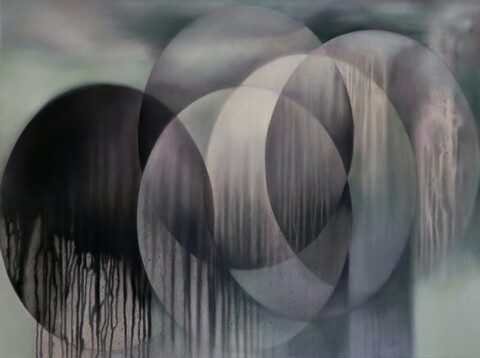
Ahn Ha Jung’s paintings rarely begin with a flawless scheme. They often start slightly askew, leaning into imbalance, where an unexpected order emerges. Stains spread, textures drift, and stones and trees appear on the canvas without conflict, each inhabiting their own quiet rhythm. It feels reminiscent of Korean traditional gardens—spaces that breathe precisely because of what they choose to leave empty. This subtle interplay of fullness and void welcomes viewers, wrapping them in a tender, almost imperceptible embrace. Her journey did not start in abstraction. In the beginning, the artist depicted trees and stones almost like tangible objects. Her many solitary mountain walks had trained her body to be near nature. She noticed how stones break, roll, and wear themselves down, losing their edges, while trees root deeply and pull water upward to grow. This contrast—between growth and silence, continuity and rupture—drew her into asking how humans are like and unlike nature. Gradually, her inquiries moved from figurative borders toward the flows of abstraction.
“I began with figuration, but at some point, I found myself inside abstraction. Even now, I think figuration remains within me, though others might only see abstraction,” the artist reflects. Her paintings seem to hold forms, only to dissolve, then form again, forever trembling on a boundary. This recalls Nicolas de Staël, whose abstractions always contained the undercurrents of lived landscapes. Even when Ahn Ha Jung’s works look purely abstract, beneath them lie memories of trees and stones, carrying the pulse of the real. Within these shifting forms, she weaves uniquely Korean concepts of Gi-Un-Saeng-Dong (vital movement), the eloquence of voids, and an intuition that embraces imbalance.
A Gate Between Taboos and Possibilities — The Weightless Fissure
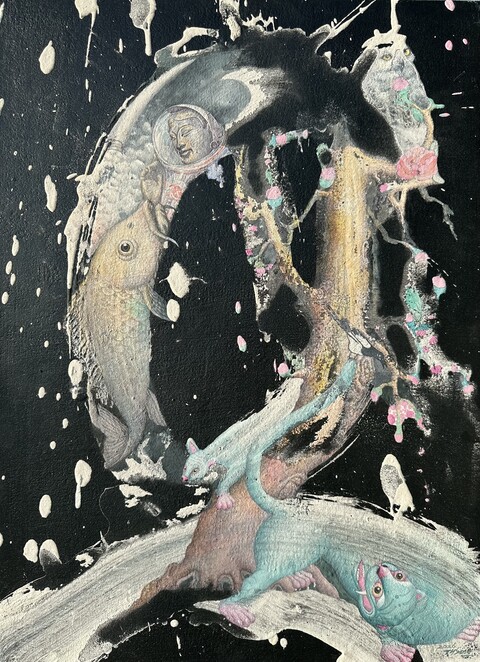
It is here that the artist’s notion of “boundaries” becomes most distinct. She does not see them as fixed lines to be drawn. Instead, she deliberately breaks them down, then patiently allows them to emerge again within the painting. Thus, her boundaries never remain stable. They become clear for a fleeting moment before blending into stains and delicate lines, gently dispersing. This is where consciousness lightly brushes against the unconscious—yet the artist does not linger there. She always steps beyond, seeking newer, more unfamiliar openings. Across her canvases, elliptical voids (o) repeat. Critic Kho Chunghwan once read them as “inky abysses,” places of silence and sorrow. But they are not merely empty. They are paradoxical points where taboo meets possibility. When we reach a psychological boundary, it becomes a taboo—like the symbolic prohibitions Lacan described, which stop us from crossing certain lines. Yet the artist’s voids invite us to doubt these taboos. They beckon us toward the outside, as if echoing how Lévi-Strauss dismantled mythic taboos to imagine other worlds. They are dark, perhaps daunting, but always slightly ajar—like Christopher Nolan’s wormholes, or the open door in Velázquez’s Las Meninasthat hints at another dimension. These voids wait for viewers to step closer, confront their own unspoken prohibitions, and peer beyond them. Thus, the artist’s paintings become a threshold where taboos turn into doors, transforming hesitation into silent possibilities.
Ahn Ha Jung describes her process simply: “I play.” She pours, splashes, and lets uncontrolled traces appear. She then pauses to see what shape emerges, intervenes with intention, only to let new accidents unfold. This cycle continues until unevenness finds balance, until the gestures of her body and the strokes of her brush create a subtle rhythm that tells her to stop. Her paintings become spaces where gravity seems to vanish, where up and down blur and distances lose their measure. Colors, textures, and voids float weightlessly, slowly drawing viewers into their suspended stillness. It is here, between the real and the unreal, that each viewer quietly completes their own inner landscape.
Harmony in the Inharmonious, Unplanned Plans — Between Space and Empathy
Ahn Ha Jung’s work always begins from what is slightly crooked, slightly off-balance. Yet from there, a new kind of harmony unfolds—one that breathes like the pauses in a Korean garden. The artist loosens and reshapes the borders between figuration and abstraction, reality and imagination. Her paintings resonate with Zhuangzi’s “Qi Wu” and “Wu Wei,” moving greatly precisely because they refuse to be forced. They also share kinship with European natural philosophies that honor cycles and regeneration. In this way, her works carry Korean voids and energies, yet flow effortlessly into universal sensibilities, quietly stirring those who stand before them.
Her canvases ultimately transcend physical space to become places of profound empathy. Viewers often find themselves encountering hidden landscapes within, or cautiously unfolding stories they did not know they carried. The artist’s time at Burg Giebichenstein deepened this approach. In Korea, she had meticulously cared for materials, finishes, and balanced compositions. In Germany, she met a freedom that valued concept and inner necessity over perfection. In this space where even incompletion was allowed, she was compelled to ask not just what she would make, but why. Through this, the subtleties of Eastern voids and philosophical intuition seeped naturally into her process, making her paintings more pliant, translating intangible, intuitive realms into uniquely Korean forces.
Looking ahead, Ahn Ha Jung will continue to embrace new materials and thoughts, carrying with her the sense of unity she felt in European forests, and quietly reframing it through a Korean sensibility. The weightless spaces she creates will someday meet the most tranquil places in our hearts, infusing them with the softest breath, gently opening yet another hidden world. In this way, her paintings lead us back to ourselves—subtly, but with a depth that lingers long after we have stepped away.
Mehr
Weniger