The American artist Keith Haring was one of the most important artists in the New York art scene in the 1980s.
He was a co-founder of 1980s Pop Art and also of the graffiti scene. Along with Roy Lichtenstein and Andy Warhol, he is considered one of the Pop Art icons of his time. As one of the first street artists, Haring made this new artistic language socially acceptable. Keith Haring made history as the greatest and most influential street artist „of all time“! If you asked Keith Haring about his role models, he would say that alongside Pablo Picasso, Walt Disney was at the forefront of his mind. He began drawing comic strips as a child. Keith Haring developed his motifs in clear lines without any preliminary drawings.
In 1976, Haring began studying commercial art at the Ivy School of Professional Art in Pittsburgh. In 1978, he exhibited at the Pittsburgh Arts and Crafts Center and shortly thereafter moved to New York, where he enrolled at the SVA (School of Visual Arts), which he left in 1980. At the SVA, Haring met Jean-Michel Basquiat. From then on, he organized exhibitions (at Club 57) and began making his first graffiti tags as a street artist.
He quickly became known for his crawling baby tag and his little dog. His Subway Drawings (1980-85) were popular in New York.
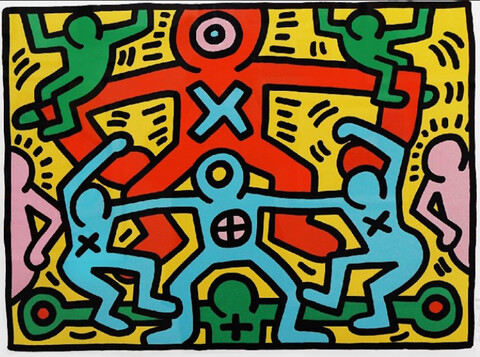
Keith Haring deliberately chose not to title his artworks so that the complexity of meanings would do justice to the diversity of people and their emotional interpretations. The recognizability of the clear forms and color surfaces, which can be absorbed at a glance, characterized his work. His Subway Drawings were quickly projected onto the walls, resulting in around ten thousand images being created in the New York subway system between 1980 and 1985.
From 1982 onwards, Haring created labyrinthine images that fit into the respective surface.
After an exhibition in New York, he was in demand internationally in the art world and traveled to
- Rotterdam,
- Amsterdam
- and to documenta 7 in Kassel.
The Spectacolor billboard in Times Square illuminated Haring’s animations for over a month.
- In 1983, Keith Haring participated in the São Paulo Biennial and the Whitney Biennial.
That same year, Keith Haring became friends with Andy Warhol and painted an Andy Mouse for him, a hybrid of Warhol and Mickey Mouse.
In 1984, Haring painted huge street art murals in Manhattan, Minneapolis, Rio de Janeiro, Melbourne and Sydney.
A year later (1985), Haring discovered canvas, which became his picture support alongside paper, vinyl tarpaulins and the exterior and interior walls of houses.
A mural was created in the Grande halle de la Villette for the 1985 Paris Biennale.
Keith Haring was 27 years old and had his first solo museum exhibition at the CAPC (Museum of Contemporary Art) in Bordeaux.
This was followed in 1986 by exhibitions at the Stedelijk Museum Amsterdam, which stretched strips of paper along the walls and allowed the artist to create spontaneously on-site. Haring called the paintings in this exhibition AMSTERDAM NOTES. They were ink drawings with red borders, a good 38 meters long – arguably the artist’s largest museum works.
In 1989, the artist founded the Keith Haring Foundation, and what was arguably his last public mural was created in 1989 on the exterior wall of a church in Pisa – it enlivens an area of 140 square meters.
The following year, Keith Haring died in 1990th in New York.
(H.W.)