Menu
art karlsruhe
An event presented by

Galerie Alessandro Casciaro

Fondamenta San Giacomo 199, 30133 Venedig
Kapuzinergasse 26/a, 39100 Bozen
Italy
Telephone (+39) 0471 975461, (+39) 328 212 4435
info@alessandrocasciaro.com

Location

  •   Hall 1 / H1/B27

Contact

Alessandro Casciaro

Phone
+39 328 2124435

Email
info@alessandrocasciaro.com

Our range of artists

Our Artists

Artist details

Category: Gegenwartskunst

Giovanni Castell

For years now this German artist has been continuing his quest to combine complex digital manipulations of photography with architectural elements or virtual spaces. He does not seek to reproduce reality, as is the case with photography, but rather to create a new reality, an individual place or a landscape, with the aid of an obvious technique distinctly reminiscent of painting. If his previous works were characterised by strong objective and narrative elements, his new cycle is almost introspective. The references he makes to other artistic movements (the way he draws on the iconography and the colouring of American abstract expressionism is undeniable) highlight the close relationship which the artist perceives between the product of his own imagination and reality as he experiences it, and the heritage left to us by the masters of classical painting. It represents a form of veneration, whilst simultaneously regenerating and reactivating his work. Castell draws inspiration and creative impulses from moments of peace and contemplation. According to the artist, this is rather like dreaming. Much is stored in our subconscious mind and can be conjured up in moments of peace and quiet. The pictures created in this way refer less to actual events or definite stories, but rather portray an underlying mood, the inner feelings and sentiments of the artist, although they are also to do with allegorical symbols and collective thoughts. Motifs and images from different worlds and times, fragmentary traces from the past, the present and a projected future, are grouped together and give rise to a plethora of interpretations and associations.

More Less

Category: Gegenwartskunst

Andrea Facco

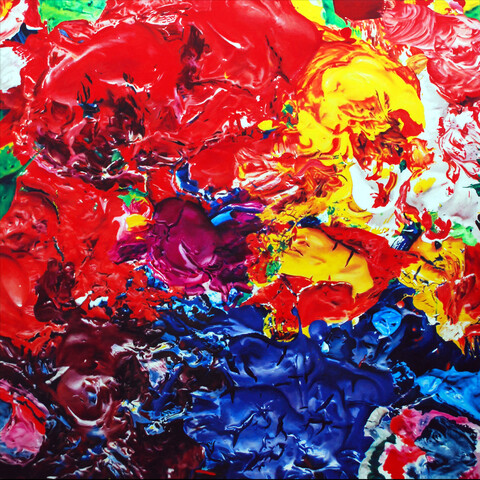
Andrea Facco’s work has always moved along the edge between painting and metapainting, between technical execution and philosophical reflection on the very meaning of the act of painting itself. In Anamnesis Pictoria, the artist presents two recent and deeply interconnected series: the Palettes and the Ghost Paintings. The Palettes are surfaces where color both explodes and settles, representing vital residues of a daily practice that carries the full density of the pictorial process. Each palette keeps the memory of gesture and time of the artwork, absorbing shades that no longer belong to a finished painting, documenting its material shadow and its condition of possibility. These are traces, marks, energetic fields from which color becomes an autonomous subject, freed from the need of representation. It is from these sedimentations that the “greycolor” takes origin, obtained from the runoff of brushes rinsed in water during the painting process. This apparently neutral, leftover substance gives birth to the Ghost Paintings: copies of lost, destroyed and stolen works, permanently denied to our gaze. From Morandi to Caravaggio, from Raphael to Klimt, the series faces with an hopelessly missing iconic heritage, evoking a phantom-like presence. The canvases, executed at a one-to-one scale with the originals, appear as grey apparitions, suspended between homage and impossibility, between memory and absence. The dialogue between the two series is necessary: while the Palettes preserve the vitality of color, the Ghost Paintings reveal its absence, turning painting into a metaphysical connection between what exists and what no longer is. Chromatic matter, regenerated from residue, becomes a medium for radical reflection: painting not merely as image, but as embodied thought, as critical memory, as an act of restitution. In this dual tension, between fullness and absence, between presence and phantom, Andrea Facco reaffirms the centrality of painting as a practice of knowledge and an act of resistance.

More Less

Category: Gegenwartskunst

Robert Pan

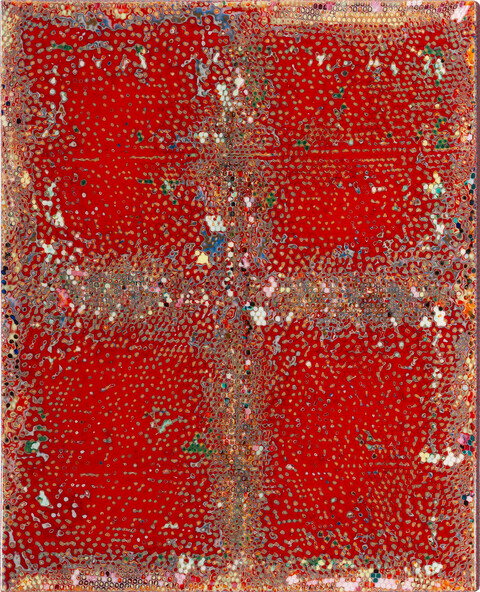
The impact of the works of Robert Pan derives from their beauty of concept and construction, from the intensity and splendor of their colors, from the exactitude and sure effect of the way those colors are nuanced. The pigments are applied in numerous successive layers, sealed in resin, and filed and polished, all in the light of carefully construed relationships between areas of opacity and transparence. Pan’s craftsmanship is the vehicle for the achievement of a multidimensional experience of color in which larger and more complex tones result from the varying articulation of the hues that resonate beneath them. Robert Pan has always looked askance at the obvious and has once again decided to voyage into places outside the realms of reason. He complicates our vision of daily experience, leading us beyond the extant and into the Eden of imagination, at the antipodes of objective observation. He allows us to grasp both the visible and invisible, material physicality and immaterial idea, the indeterminate point of view no less than the world of imperceptible detail, the metaphoric flowing of color and the immutable solidification of resins.

More Less

Category: Gegenwartskunst

Josef Rainer

Josef Rainer was born in 1970 in Bressanone (I). Between 1991 and 1997 he attended the Academy of Fine Arts in Munich. From 2001 to 2003 he received a scholarship in Vienna and since 2003 has divided his time between Dufftown and Scotland. In 2008 he stayed in London and in 2010 
in Vienna. In 2019 he won the HGV Artist of the Year award. He currently lives and works in Bressanone.

More Less

Category: Gegenwartskunst

Kinki Texas

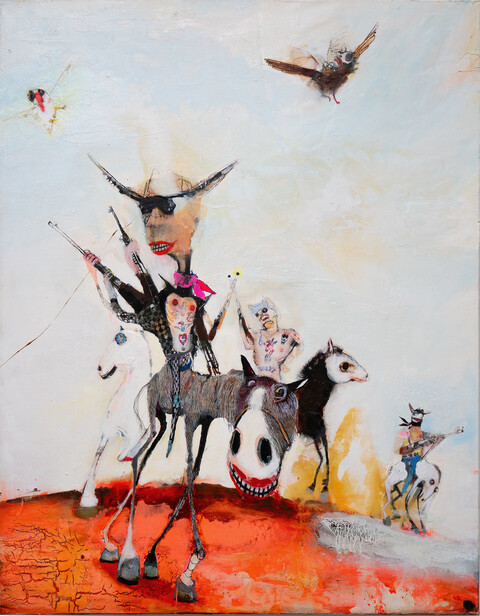
Presented on large-scale canvases and depicted in vibrant, almost lurid colours, Kinki Texas’s subjects may appear to have been quickly dashed off but have in fact been developed over a period of months. Their lengthy process of creation is only revealed on closer inspection, when the different stages of the picture’s evolution can gradually be traced. While Kinki Texas has a particular theme and subject matter in mind when he begins working on his pictures, he also reacts to what happens during the painting process, with the result that the development of the images can take unexpected turns. He paints, sprays, writes, wipes and scrapes away until he reaches a state where any additional painterly touch would overload the image, but any missing one would make it seem unfinished. The heroic figures in “Kinki Texas Space”, this is what the artist calls his creative universe, which draws as much inspiration from the comic genre as it does from television’s History Channel, employing means of depiction borrowed from graffiti and trash culture as well as from centuries of history painting, their appearance ranges from slightly strange to truly bizarre; some of them have a warlike and at times rather frightening demeanour; they confront the viewer with loaded guns, pose in suits of armour with swords drawn or like Native Americans with headdresses, bows and arrows.

More Less

Category: Gegenwartskunst

Antonello Viola

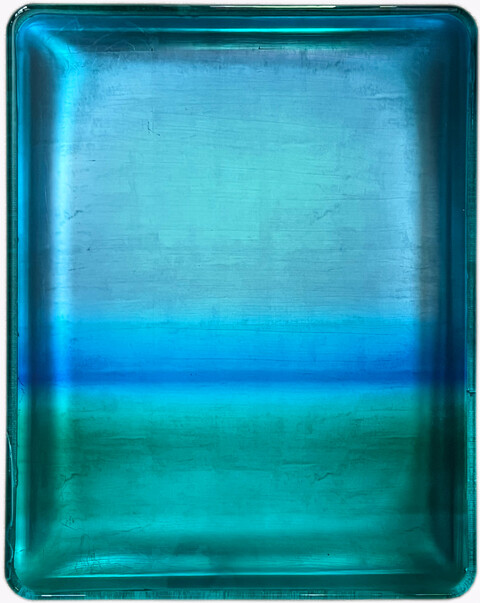
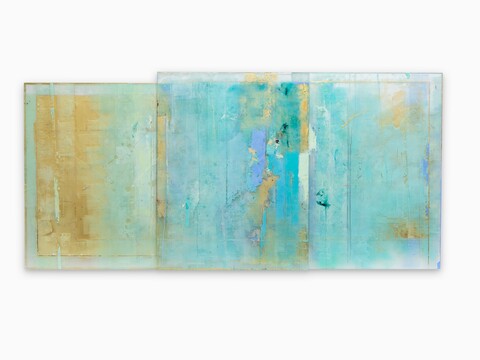
The islands of Elba, Tavolara, Giglio, Le Camere, but also Favignana and Palmarola: each work on glass by Antonello Viola is inspired by an island, giving shape over time to an imaginary and highly personal archipelago in which the physical characteristics of each island dissolve into hazy chromatic chords. The work with its distinctive architecture, which is emphasised by the transparency of the glass, simulates the mechanism of memory by reproducing a real experience or a fantastic evocation. Like a recollection, which often appears in the mind not as a clear vision but as a vague, fragmentary image, an impalpable impression, so the islands painted by Viola capture on glass the chromatic substance, the reflection of that essential union of sky, water, light, vapour, sand, rock, which is made manifest in the island – or in the idea of that island. Just as in memory, the elements of the landscape in Viola’s works do not appear in an orderly sequence, but overlap and interpenetrate each other and seem over the course of time to have settled themselves in their residual chromatic essence on the glass panels. Time as the measure of painting. The image of the places is broken down into its familiar colours and shapes and reassembled in combinations in which the space and time of the earthly elements can be recognised, but only out of the corner of the eye, by abandoning oneself to the perception of the senses. Each element is not crystallised in a closed form, but rather, as a sign placed in relation to the others, evokes the incessant transformation of matter that changes its state, of rock that becomes sand, of the constant movement of the sea, of water evaporated by the sun, foamed by the waves and the wind. Islands are par excellence territories whose boundaries shift, which are constantly redefined by the tides, vibrating with the reflections of light on the water that surrounds them.

More Less

Category: re:discover

Wainer Vaccari

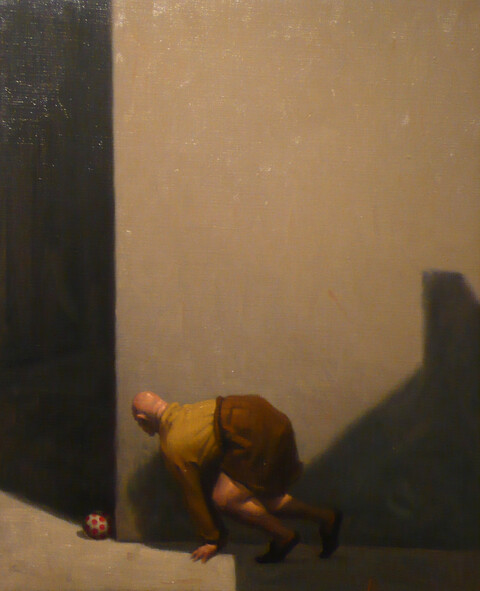
Wainer Vaccari was born in Modena in 1949 and made his debut as an artist in the 1970s. After an initial creative phase influenced by surrealism, he moved towards German New Objectivity, with a particular focus on figurative painting bordering on mannerism, creating paintings featuring figures, often with a strong physical structure, embedded in a mysterious and enigmatic world populated by fantastic creatures in a visionary and enchanted atmosphere. Around the 1980s, after the initial influence of German New Objectivity had waned, his painting began to engage with the Mannerist art of 16th-century Italy and the visionary figuration of 19th-century Northern Europe. The results of this research prompted Vaccari to expand his exhibition activities beyond the borders of Italy, which was met with a positive response from important European institutions. The results of this research prompted Vaccari to expand his exhibition activities beyond the borders of Italy and Switzerland (where he grew up), which was met with a positive response from important European institutions, especially in Central Europe. The turn of the millennium marked another turning point in Vaccari's artistic career. The year 2000 was characterized by an intense exploration of visual language, which led him to fundamentally rethink his expressive grammar. Subsequently, from 2012 onwards, Vaccari's reflection on painting was combined with intensive epistemological study, which led the artist to a new and original development of his imagination and style. The artist currently lives and works in Modena (I).

More Less

About us

Gallery profile

The Alessandro Casciaro Art Gallery is an international, art gallery presenting modern and contemporary masterpieces by some of the most significant Italian as well as central European artists, selected for the quality of their quest and the uniqueness of their pictorial language, alongside works by emerging young artists, promoting them and developing their international profile.
Founded in Bolzano in 2015 by Alessandro Casciaro as a successor to the Goethe Gallery, the first art gallery in South Tyrol (founded in 1964 by Ennio Casciaro), the Alessandro Casciaro Art Gallery can now look back on more than sixty years of important exhibitions, independently curated catalogues, collaborations and arts fairs, with the aim of providing varied and intense stimuli and objectives for the future of contemporary art in both Italy and Europe.

More Less

Company data

Foundation

2015